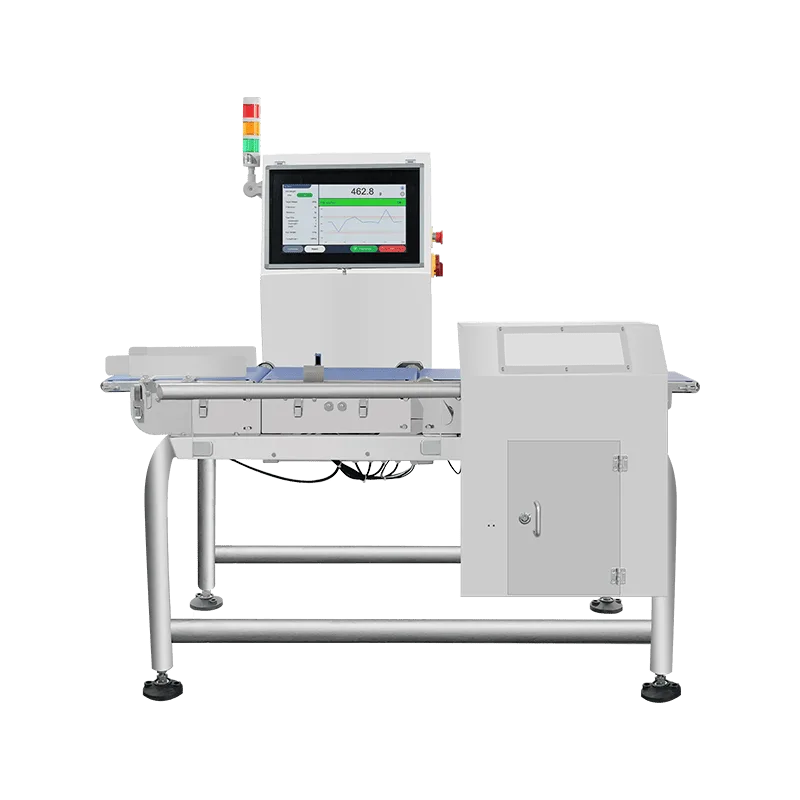
Choosing the right system for food products starts with a production question: what must the weighing point actually control? A processor may need to identify underweight packs, remove overweight units, verify missing components, or keep portion sizes within a defined range.
The best selection therefore depends less on buying the most advanced machine and more on matching the equipment to the product, line speed, and inspection objective. Easyweigh provides several checkweighing configurations, making the selection process easier when these variables are defined first.
Which Food Product Is Being Weighed?
Product weight and physical format should be the first filters. A small pouch, a tray of poultry, a prepared meal, and a large carton create different weighing conditions. Product dimensions also determine whether the conveyor can provide enough stable travel for an accurate measurement.
Movement is equally important. Flexible packages can shift during transport, while irregular food products may not sit in exactly the same position from one item to the next. Buyers should therefore identify the lightest and heaviest products, package dimensions, surface characteristics, and expected product spacing before comparing models.
What Weight Range Must the Line Control?
The required weighing range should reflect the actual SKU portfolio rather than a theoretical maximum. A machine selected around a narrow product range may become restrictive when new package sizes are introduced. Conversely, choosing a much larger capacity than necessary can make the system less appropriate for small, sensitive weight differences.
Accuracy should also be tied to the production objective. The published high-speed model offers nominal accuracy up to ±0.1 g for products within a checking range of 50 g or less. Its general-purpose dynamic model is listed at ±0.3 g to ±1 g, showing why accuracy cannot be evaluated separately from product weight.
Note: All values are nominal specifications obtained under ideal test conditions. Real‑world dynamic weighing performance is affected by line‑speed, vibration, product characteristics and factory‑floor environmental conditions.
Can the Machine Keep Up With the Production Line?
A suitable checkweigher must fit the required production rate. Buyers should calculate units per minute, conveyor speed, product spacing, and the maximum number of products expected during peak production. A weighing system that cannot maintain the required flow can create a bottleneck even if its measurement capability is otherwise suitable.
The published specifications illustrate the difference between machine categories. The general-purpose dynamic model is listed with a nominal working speed of 20–90 m/min, while the heavy-weight model is listed at 15–35 m/min. The right choice depends on the relationship between package weight, dimensions, and required throughput rather than speed alone.
Note: The stated figures refer to conveyor belt linear speed, not product‑handling throughput in pieces per minute. Actual usable operating range is affected by product size, feeding stability and factory‑floor conditions.
What Should Happen to Products Outside the Target?
Weighing is only one part of the control decision. Once an item falls outside the acceptable range, the line needs a reliable way to separate it from accepted production. The rejection method should suit both the product and the available conveyor layout.
Pushers, air jets, and diverters are among the rejection approaches identified by the supplier. Fragile packages may require gentler handling, while heavier or rigid packs can demand a different mechanical arrangement. Space after the weighing point also needs to be checked so rejected products do not interfere with accepted items.
How Will the Weighing Point Fit Existing Equipment?
Integration should be assessed before a model is finalized. Conveyor width, product direction, line height, available floor space, electrical requirements, and the location of upstream and downstream machines can all influence the practical installation.
The inspection point may also sit beside other quality-control equipment. The supplier states that its inline checkweighers can integrate with metal detectors and X-ray systems. For a food processor, this can influence the overall layout because several inspection stages may need coordinated product flow, controls, and rejection handling.
Which Model Fits the Actual SKU Mix?
A useful selection exercise compares models against real production data instead of comparing headline specifications alone. The buyer can create a simple matrix covering product weight, package dimensions, target tolerance, units per minute, conveyor conditions, and rejection requirements.
A general-purpose dynamic configuration is available for products such as snacks, poultry, fish, seafood, and fruit, while the heavy-weight configuration is designed for larger packages with capacity up to 50 kg. Easyweigh presents these differences to show why model selection should follow the SKU mix and production profile.
Note: These are nominal model‑specific specifications. Actual weighing performance depends on product characteristics and factory‑floor operating conditions.
Why Product Trials Should Decide the Purchase
Catalog specifications narrow the options, but representative product testing provides the strongest final check. As an original equipment manufacturer, Easyweigh delivers both standard‑specification machines and custom OEM / ODM solutions to adapt equipment for unique line layouts and special processing requirements. Prospective buyers can submit real product samples for professional performance testing before final procurement decisions. Samples should be run at the intended operating conditions, including normal product spacing and relevant package variations.
The trial should examine whether products remain stable through the weighing section and whether rejected items are separated consistently.
The final decision should balance accuracy, throughput, handling, integration, and the expected range of products. A system that performs well with one SKU but struggles with another may create problems after installation.
Testing several representative products gives engineering and quality teams evidence for selecting a configuration that matches the real production environment.
A food producer does not need the same weighing setup for every product. The better decision comes from defining the products first, translating their weights and flow rates into equipment requirements, and then checking rejection and integration details.
Easyweigh can be considered within that process as a supplier of different checkweighing configurations, while its available models should be assessed against the actual production profile.
