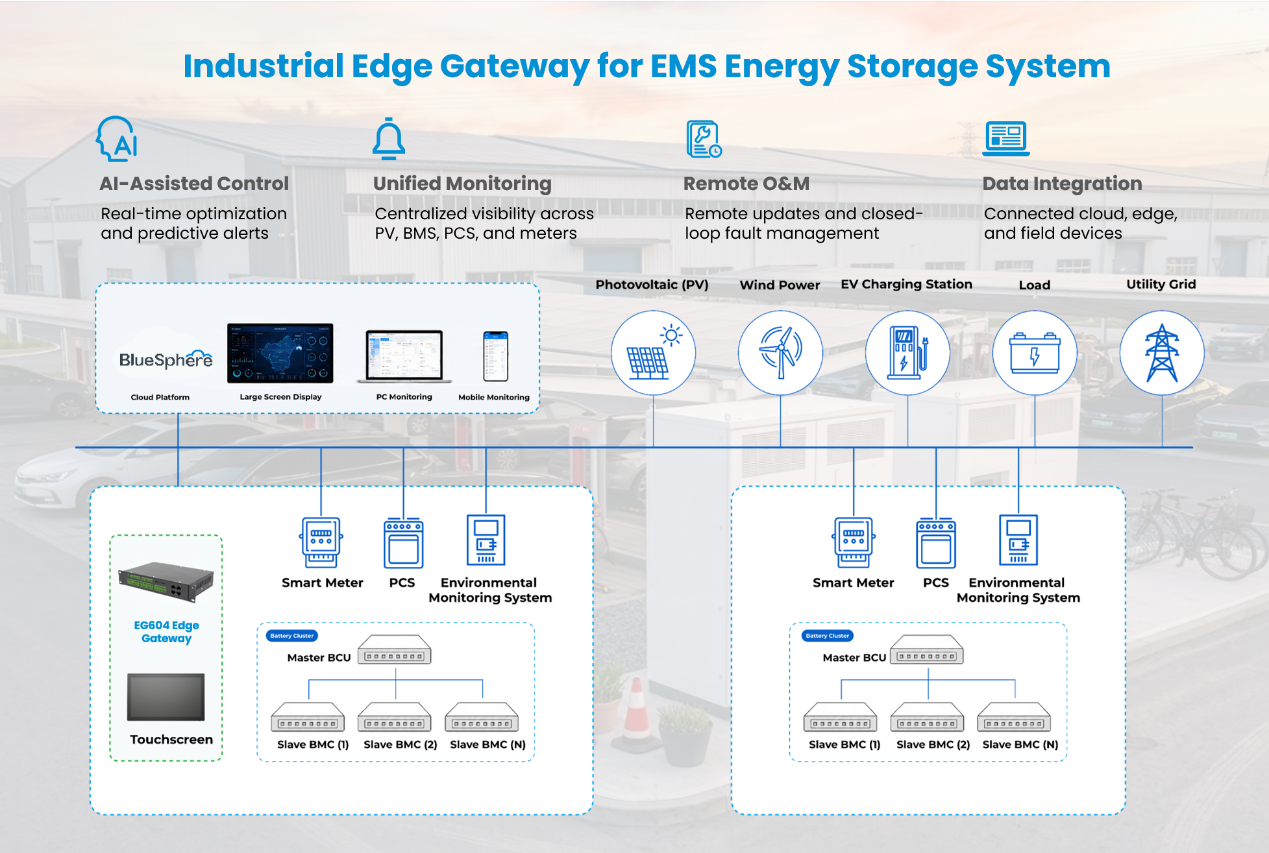
Energy-intensive facilities need accurate, timely information to control consumption, identify equipment problems, and improve operational efficiency. Yet meters, controllers, inverters, and energy storage systems often use different communication interfaces. Remote monitoring gateways help unify these data sources, connect field equipment with management platforms, and give engineering teams better visibility across distributed energy assets.
The Connectivity Challenge Behind Energy Monitoring
Energy management involves more than collecting electricity readings. Industrial plants may need to track peak demand, power quality, equipment operating status, photovoltaic generation, battery performance, and HVAC consumption. Each data source provides a different part of the operational picture.
Integrating these systems can be difficult when devices use different protocols or belong to different equipment generations. Some meters communicate through RS-485, while controllers may use industrial Ethernet. Remote installations can add another challenge because they may lack reliable, wired internet access.
A suitable gateway creates a common communication layer between field devices and monitoring software. Before choosing hardware, project teams should identify the required data points, update intervals, network conditions, and operational decisions the collected information must support.
Connecting Field Equipment to Central Monitoring Systems
A computing gateway can collect information from meters, PLCs, inverters, and other industrial devices before forwarding it to a local server or remote platform. Depending on the selected model, it may support protocol conversion, data filtering, aggregation, and local processing.
Consider a manufacturing facility that operates several production lines. Energy managers may need to compare electricity consumption with machine operating schedules. By collecting meter readings and equipment states through a unified architecture, they can investigate unusual overnight consumption or identify lines with higher energy demand.
The gateway can also help standardize how data reaches downstream applications. Engineers should verify that values retain the correct units, timestamps, and scaling during transmission. Incorrect mappings can distort reports and lead to poor operational decisions, even when the physical communication connection appears stable.
Choosing Between Local Processing and Cloud Analytics
Not every energy application needs the same computing architecture. A small installation may require basic data forwarding, whereas a distributed energy project may need local event detection, temporary storage, and more advanced data handling.
Local processing allows selected operations to happen near the equipment. A gateway may filter repetitive measurements, calculate interval values, or trigger a configured alert when a threshold is exceeded. These functions can reduce unnecessary data transmission and support faster responses when the application and device capabilities permit.
Cloud or server-based systems remain valuable for long-term historical analysis, comparisons between sites, reporting, and centralized dashboards. A practical architecture divides responsibilities according to computing needs, connectivity constraints, and response requirements.
For an edge gateway IoT deployment, buyers should examine which functions genuinely run on the device and which depend on external software. They should also confirm local buffering capacity, data recovery behavior, and whether timestamps remain consistent when the network connection is interrupted.
Designing for Industrial Networks and Site Conditions
Protocol compatibility should be confirmed before procurement. Create a device inventory that records the required communication standards, physical interfaces, register maps, and connection roles. Check serial and Ethernet port counts, supported baud rates, and the gateway’s ability to communicate with the selected controllers. Where multiple protocols are involved, test representative devices rather than relying on a general compatibility statement.
The physical environment also matters. Energy equipment may operate in electrical cabinets exposed to temperature variations, electrical interference, dust, or vibration. Review operating temperature, input voltage, isolation, mounting options, and enclosure requirements against actual site conditions.
Network resilience deserves equal attention. Remote installations may depend on cellular connections, particularly at renewable energy sites or facilities with limited network infrastructure. Depending on the model, dual-SIM connectivity, link failover, or automatic recovery may help maintain communications. Confirm carrier availability, signal strength, and recovery behavior during commissioning.
Protecting Data and Maintaining Remote Access
Energy monitoring systems can support important operational decisions, so connectivity must be designed with security in mind. Separate operational technology networks from general business networks where appropriate, restrict access to necessary services, and establish procedures for credential management and software updates.
Remote access should follow the organization’s cybersecurity policies. VPN connectivity, encrypted communication, access permissions, and security logging can help form a controlled management approach when supported and correctly configured.
Operational teams should also plan for maintenance. Ask suppliers about diagnostic tools, technical documentation, SDK availability, software support, and remote troubleshooting options. For distributed deployments, centralized monitoring and controlled over-the-air updates can reduce the need for repeated site visits, although the available functions depend on the product and its software configuration.
Assessing Solutions Beyond the Initial Purchase Price
The lowest-priced gateway may not deliver the lowest overall deployment cost. Integration labor, commissioning time, network subscriptions, downtime, and long-term maintenance all affect project economics.
A structured pilot helps reveal these costs before a large rollout. Start with representative meters and controllers, compare gateway data against source readings, and test behavior during communication failures. Measure missing data intervals, reporting accuracy, recovery time, and the effort required to diagnose issues.
For broader deployments, consistency becomes increasingly important. Standardized device naming, documented data mappings, reusable configurations, and centralized device oversight can simplify expansion across buildings or multiple energy sites.
Vantron’s digital energy solutions include edge computing gateways for industrial communication and data transmission, alongside embedded devices and the BlueSphere platform. The appropriate configuration depends on project requirements, so confirm each model’s protocols, networking options, processing functions, and remote-management compatibility before making a purchasing decision.
Building a More Practical Energy Monitoring Strategy
A remote monitoring gateway is most valuable when it connects reliable field data with decisions that improve energy operations. The right solution should match the existing equipment, withstand site conditions, support secure connectivity, and provide the processing functions the application needs.
Start with a defined operational objective, validate the complete data path in a pilot, and expand after confirming the results. Explore relevant gateway options through Vantron and evaluate the specific hardware and software configuration against long-term integration and maintenance requirements.
