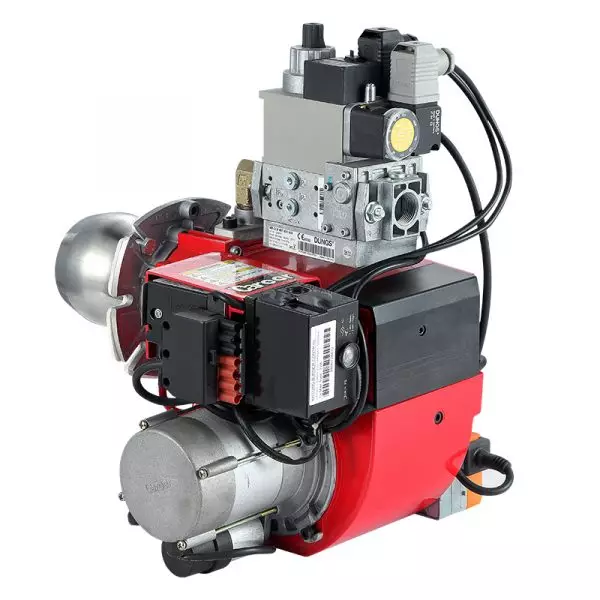
Gas burner ignition is the controlled sequence that changes a burner from a stopped condition into stable combustion. In an industrial heating system, ignition is not simply a spark touching gas. The burner must establish the necessary air conditions, introduce fuel under controlled conditions, create an ignition source, and confirm that a flame has been established before continuing normal operation.
For a gas burner boiler, this sequence is important because combustion must be established predictably before the burner can deliver useful heat to water, steam, or another process medium.
Ignition Begins Before Gas Reaches the Flame
A typical industrial ignition sequence starts with a demand for heat from the burner control system. Before fuel is released for ignition, the system establishes the conditions required for combustion.
Combustion air is supplied through the burner’s air system, while safety and control devices verify relevant operating conditions. The exact sequence depends on the burner design and control architecture, so industrial equipment should always be operated according to its specified procedure.
Career Burner lists automatic-control gas burners with functions including flame detection, air-pressure monitoring, and gas-pressure monitoring. These functions illustrate why ignition involves more than activating an ignition electrode. The burner needs controlled operating conditions before and during flame establishment.
Once the required conditions are established, the ignition sequence can proceed to controlled fuel introduction.
How the Ignition Source Starts Combustion
Gas and combustion air must reach an appropriate relationship at the ignition point. An ignition device then supplies the energy required to initiate combustion.
In many industrial gas burners, an electrical ignition system creates a spark between electrodes. The spark provides an ignition source for the fuel-air mixture. Once combustion begins, the resulting flame must remain stable rather than disappear immediately after ignition.
The ignition stage therefore depends on several components working together: fuel delivery, combustion-air supply, ignition hardware, burner geometry, and the control system coordinating their operation.
Gas burners can be configured for different fuels and firing capacities. Career Burner’s gas burner range, for example, includes equipment designed for natural gas, LPG, and various process gases, with listed burner capacities extending across different industrial heating requirements.
The fuel itself therefore forms part of ignition-system selection. Gas characteristics can affect the required combustion arrangement and operating conditions.
Flame Detection Confirms Successful Ignition
Creating a spark is not the same as proving that combustion has successfully started. Industrial burners therefore use flame supervision to determine whether a stable flame is present.
A flame detector monitors the combustion condition after ignition. If the expected flame signal is not established, the control system can prevent continued fuel firing rather than allowing gas to accumulate without successful combustion.
This function is especially significant in a gas burner boiler because continued fuel admission without confirmed combustion would not provide useful heat and could create an unsafe operating condition.
Career Burner identifies flame detection as part of its automatic burner-control configuration. The same product information also identifies automatic safety functions and monitoring of gas and air pressure.
The ignition sequence is a verification process: the system does not simply command ignition; it checks whether ignition produced the expected combustion state.
What Happens After the Flame Is Established
Once the flame has been successfully detected, the burner transitions from ignition into normal firing. Fuel and combustion air continue to be regulated according to the required operating condition.
The burner may then operate at a fixed firing level, through stages, or with modulation depending on its configuration and the requirements of the heating equipment. The purpose is to maintain the thermal output required by the process rather than remain permanently in the initial ignition condition.
Career Burner’s product category includes automatic, two-stage, and modulating gas burner configurations. Such arrangements allow burner operation to be matched to different heating requirements.
For a boiler, the subsequent firing stage transfers combustion heat through the boiler’s heat-transfer surfaces. In other industrial equipment, the flame may heat air, materials, process vessels, or combustion chambers directly or indirectly.
Why Ignition Sequence Matters in Industrial Heating
Industrial heating equipment can operate for long periods and may start and stop repeatedly according to production requirements. A reliable ignition sequence reduces dependence on manual intervention and provides a defined procedure for establishing combustion.
Automatic control also connects ignition with the rest of burner operation. Pressure monitoring, flame supervision, fuel control, and combustion-air management can work within the same sequence rather than being treated as unrelated functions.
The specific burner configuration determines how these stages are implemented. Career Burner provides gas burner systems for applications including boilers, ovens, dryers, furnaces, and other industrial heating equipment, demonstrating that ignition technology must ultimately be matched to the thermal application.
Ignition should consequently be evaluated as part of the complete combustion system rather than as an isolated component.
From Ignition to Stable Heat Output
The fundamental ignition process is sequential: a heat demand initiates the start procedure, combustion air is established, fuel is introduced under controlled conditions, an ignition source initiates combustion, and flame detection confirms successful ignition. The burner can then transition into its normal firing mode.
For industrial heating systems, this sequence provides the bridge between a stopped burner and controlled thermal output. In a gas burner boiler, that bridge must be reliable because useful heating cannot begin until combustion has been established and verified.
Understanding this sequence also clarifies why burner selection involves more than choosing a fuel capacity. Ignition equipment, flame supervision, fuel-air control, pressure monitoring, and the burner’s operating mode all contribute to how reliably the system moves from startup to stable combustion. Properly integrated, these elements allow industrial gas burners to establish the flame in a controlled manner and then maintain the heat required by the process.
