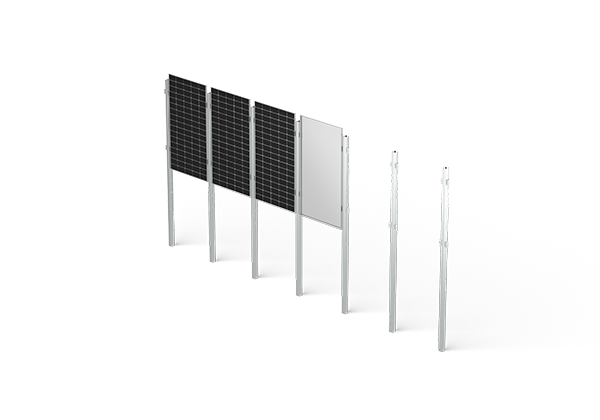
Vertical photovoltaic mounting is gaining attention across a broader range of land-constrained and dual-use applications. Antaisolar’s 2026 exhibition materials identify vertical ground mounting as a solution serving rapidly growing niche applications, while its vertical mounting portfolio covers settings such as pastures, fences, highways, and guardrails. These use cases place new demands on module compatibility, terrain adaptation, foundations, electrical layouts, and maintenance access.
In 2026 project planning, solar panel vertical mounting can be evaluated through land-use value, hourly production shape, constructability, safety, and adaptability alongside installed capacity. Antaisolar‘s vertical solution reflects these considerations through space utilization, enclosure functionality, customized design, and applications in pastures, fences, highways, and guardrails.
Standardizing Modules Without Ignoring the Site
Modularity begins with repeatable posts, rails, clamps, splice details, fastener families, and installation sequences. Standard interfaces can simplify bills of material, quality inspection, packing, training, and spare parts. Adjustment ranges still need defined structural limits so field flexibility does not become uncontrolled variation.
Large-format and bifacial modules are changing span, clamp-zone, wind, handling, and cable requirements. A modular platform should clearly define compatible dimensions, structural limits, and applicable load conditions where necessary. Unverified drilling or field-fabricated extensions can weaken capacity and undermine traceability.
Around its vertical system, Antaisolar provides tailor-made design and customized production. The most scalable approach separates genuinely project-specific elements, such as foundations or end posts, from standardized repeatable units, allowing customization without redesigning every connection along the array.
Digital design is also becoming more important. Parametric layouts can connect survey data, row quantities, foundation schedules, shading checks, cable routes, gates, and material takeoffs. Revision control ensures that factory labels, packing lists, installation drawings, and field changes continue to describe the same configuration.
Expanding Dual-Use and Boundary Applications
Land competition is encouraging structures that perform more than one function. Vertical arrays can follow pasture divisions, property fences, transport corridors, or guardrail zones while generating electricity. The combined use requires coordination with animals, vehicles, public access, vegetation, sight lines, emergency routes, and maintenance equipment.
The energy profile can complement other resources by shifting some output toward morning and afternoon. Bifacial energy gain, orientation, albedo, row spacing, and seasonal weather determine whether that advantage appears. Bankable models should use hourly simulations and sensitivity ranges instead of a generic vertical gain assumption.
Antaisolar describes its configuration as space-efficient, effective at capturing sunlight, capable of serving as an enclosure, and straightforward to clean. Those features should be tested through project geometry, structural loads, access planning, cleaning trials, and safety review for the exact application.
Permitting frameworks are also adapting. A structure used as both power plant and boundary may fall under electrical, building, transport, agricultural, or fencing requirements. Developers should identify controlling authorities early and establish ownership of setbacks, grounding, signage, fire access, and impact protection.
Designing for Circularity and Long-Term Adaptation
Modular construction can support repair and reuse when damaged parts are replaceable without dismantling long runs. Bolted connections, documented part numbers, compatible future spares, and accessible cable routes make adaptation easier. Material efficiency should never come at the expense of wind capacity, corrosion protection, or safe handling.
Lifecycle planning is extending beyond the initial module generation. Designers may need to accommodate replacement modules with different dimensions, changes in land use, new gates, repowering, storage integration, or partial relocation. Clear interface limits help owners judge which changes require engineering review.
Antaisolar situates vertical products alongside conventional arrays, carports, agrivoltaics, and Fishery PV systems. That wider portfolio supports configuration comparisons as land priorities evolve. Selection should consider yield, civil work, operations, shared use, future modification, and decommissioning within one decision framework.
The evolution of solar panel vertical mounting will depend on disciplined standardization paired with evidence-based customization. Systems that combine repeatable components, verified structural behavior, realistic energy modeling, dual-use safety, and maintainable interfaces are better positioned to move from demonstration projects into routine deployment.
