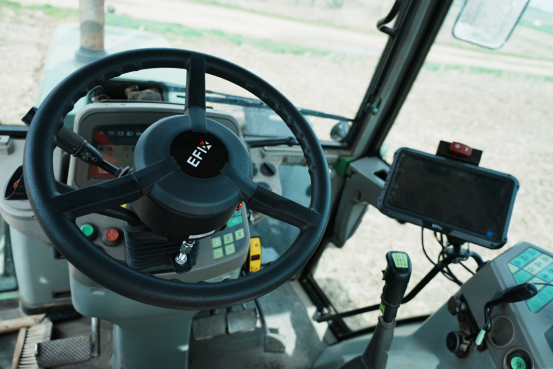
Walk onto any farm today, and you will see tractors working under vastly different conditions—open prairies, tree-lined paddocks, rolling hills, and valleys with weak satellite visibility. A single positioning method cannot handle all these scenarios reliably. That is exactly why modern autosteer for tractors must support multiple GNSS modes. Farmers who overlook this flexibility often find themselves frustrated by signal dropouts, inconsistent accuracy, or unexpected subscription lock-ins. The right system adapts to the field, not the other way around.
From SPP to RTK: Matching Accuracy to Task
Not every job requires centimeter-level precision, but every job benefits from a reliable signal. A capable autosteer for tractors offers SPP (3–5 meters) for broad-acre scouting, DGPS (30–50 cm) for fertilizer spreading, and RTK (2.5 cm) for seeding or planting rows. The eSteer10 system, for example, supports SPP, DGPS, RTK, and H-PPP (Galileo E6-HAS) within a single unit. This means a grower can switch modes based on the task without changing hardware—reducing both cost and complexity.
High-Precision PPP: When RTK Infrastructure Is Absent
Many regions lack cellular coverage or radio repeaters for RTK corrections. Under these conditions, autosteer for tractors with PPP (Precise Point Positioning) becomes a game-changer. H-PPP via Galileo E6-HAS delivers high-precision, decimeter-to-centimeter level accuracy without base stations. The practical benefit is straightforward: farms in remote areas can still achieve seed-row precision for planting and spraying, exactly where manual steering would otherwise dominate.
Speed-Independent Performance Seals the Value
Flexibility in GNSS modes only matters if the system maintains accuracy across real-world speeds. With eSteer10, autosteer for tractors holds ±2.5 cm from 0.1 km/h (ditching) to 30 km/h (high-speed broad-acre spraying or mowing). From an observer’s standpoint, this speed range eliminates the need for multiple guidance systems—one solution covers every operation.
Why Farmers Are Demanding Multi-Mode Systems
Field conditions change hour by hour. A rigid GNSS setup leads to downtime or degraded accuracy. EFIX understands this reality: the eSteer10 delivers multi-mode flexibility, high precision across all operational speeds, and reliable performance for seeding, spraying, strip tillage, and efficient harvesting. For farm managers evaluating autosteer for tractors, the choice is clear—invest in adaptability, or prepare for signal frustration. EFIX builds systems that work where you work.
